
Emory University
Department of Human Genetics
Our research program
We study how genetic variation influences disease by combining human genetics, statistics, and machine learning. We focus on both inherited genetic variants (germline) and genetic variation that arises during life (somatic), and how these interact.
Germline determinants of somatic mosaicism
We are all mosaics, meaning that we harbor genetic variation that arises during life. This somatic mosaicism is a fundamental aspect of human biology and has been implicated in a wide range of diseases, including cancer, neurodegenerative disorders, and autoimmune diseases. But why this happens, and how this happens, is not well understood.
Previous and ongoing work leverages biobank scale whole-genome sequencing (WGS) of blood to detect pre-malignant clonal expansions and to discover their germline determinants and phenotypic correlates. We are particularly interested in the germline determinants of clonal expansions of somatic point mutations in blood, spanning both canonical leukemogenic mutations as well as relatively uncharacterized recurrent non-coding point mutations.
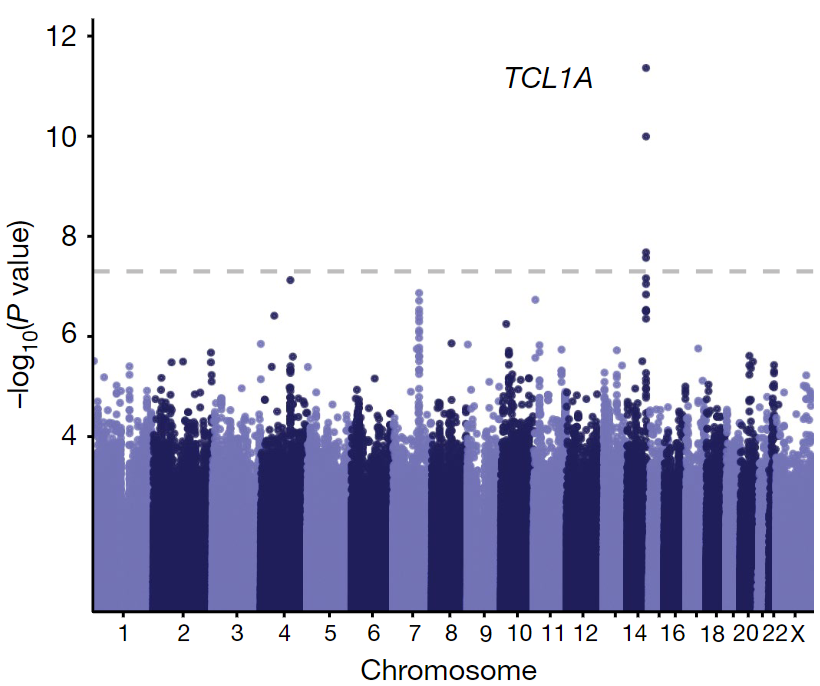
Representative papers: Weinstock* and Gopakumar* et al., Nature, 2023, Weinstock et al., Nature Communications, 2025, Weinstock et al., medRxiv, 2025
Gene regulatory networks + complex traits
Complex traits are influenced by a very large number of genetic variants, each with a small effect. Several genome-wide associaciation studies (GWAS) have shown that these variants usually lie in non-coding regions of the genome and influence disease risk by regulating gene expression. However, the mechanisms by which these variants regulate genes are often unclear.
We pair data from pooled high-content CRISPR screens with new statistical methods to map gene regulatory networks – showing which genes regulate others – to uncover the mechanisms behind these GWAS signals.
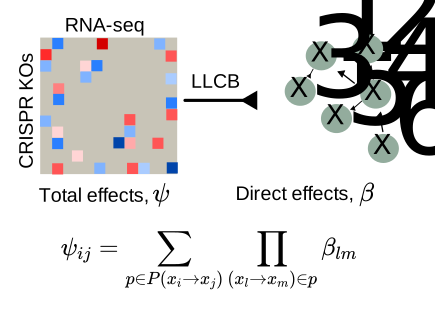
Our lab furthers this mission though bespoke computational methods development and application. Our model has been to partner closely with experimentalists to develop statistical approaches that reflect deep biological and experimental intuition. We ultimately aspire to mitigate common disease burden through our discovery and characterization of novel therapeutic targets.
Statistical modeling and machine learning for human genetics
We have a broad interest in improving the statistical modeling of genetic and genomic data to improve disease prediction from genetic data. See, for example, our recent polygenic risk score work, which improves modeling of genetic risk through integration of functional genomic annotations and a new statistical model for the distribution of effect sizes across the genome.
Affiliations
We are members of the Winship Cancer Institute and the Center of Computational and Quantitative Genetics.